
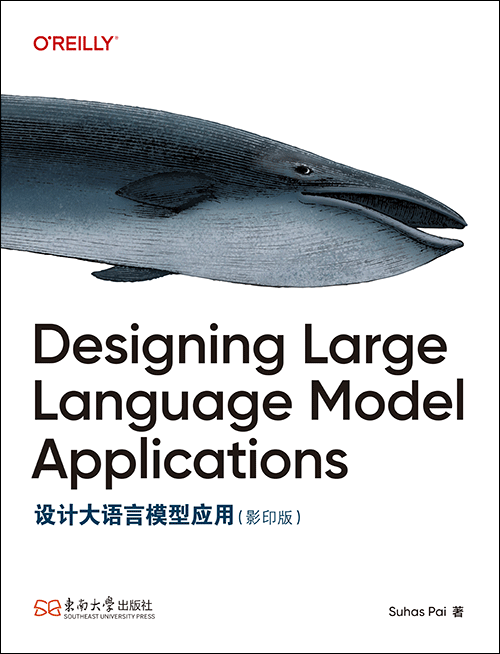
设计大语言模型应用(影印版)
出版时间:2025年07月
页数:343
“你翻阅无数论文,尝试各种工具和基准测试,花费数周甚至数月时间才弄清楚LLM的运作机制,而这一切全都涵盖在了这本书中。强烈推荐。”
——Megan Risdal
Kaggle(Google)首席产品经理
“本书是构建先进AI系统的一堂大师课。”
——Jay Alammar
Hands-On Large Language Models合著者
“这本精心策划的佳作涵盖了该领域所有重要的概念与实用知识,真是难得一见。”
——Madhav Singhal
AutoComputer首席执行官
大型语言模型(LLM)已被证明是解决各种任务的强大工具,也得到了企业界的关注。但从演示和原型过渡到真正可用的成熟应用却并不容易。本书旨在弥合这一差距,为实践者提供构建语言模型驱动产品所需的工具、技术和实操指南。
经验丰富的机器学习研究员Suhas Pai就如何利用LLM解决实际应用场景中的问题,以及如何应对常见的失败模式,提供了实用建议。你将深入了解构成语言模型的各项要素,探索诸如微调等多种定制化技术,学习RAG(检索增强生成)和智能体等应用范式。
● 理解如何为训练和微调准备数据集
● 建立对Transformer架构及其变体的直觉认识
● 将预训练语言模型适配于你自己的领域和使用场景
● 掌握微调、领域自适应与推理优化的有效技术
● 使语言模型能够与外部工具和数据对接,并将其集成进现有的软件生态系统
——Megan Risdal
Kaggle(Google)首席产品经理
“本书是构建先进AI系统的一堂大师课。”
——Jay Alammar
Hands-On Large Language Models合著者
“这本精心策划的佳作涵盖了该领域所有重要的概念与实用知识,真是难得一见。”
——Madhav Singhal
AutoComputer首席执行官
大型语言模型(LLM)已被证明是解决各种任务的强大工具,也得到了企业界的关注。但从演示和原型过渡到真正可用的成熟应用却并不容易。本书旨在弥合这一差距,为实践者提供构建语言模型驱动产品所需的工具、技术和实操指南。
经验丰富的机器学习研究员Suhas Pai就如何利用LLM解决实际应用场景中的问题,以及如何应对常见的失败模式,提供了实用建议。你将深入了解构成语言模型的各项要素,探索诸如微调等多种定制化技术,学习RAG(检索增强生成)和智能体等应用范式。
● 理解如何为训练和微调准备数据集
● 建立对Transformer架构及其变体的直觉认识
● 将预训练语言模型适配于你自己的领域和使用场景
● 掌握微调、领域自适应与推理优化的有效技术
● 使语言模型能够与外部工具和数据对接,并将其集成进现有的软件生态系统
- Preface
- Part I. LLM Ingredients
- 1. Introduction
- Defining LLMs
- A Brief History of LLMs
- The Impact of LLMs
- LLM Usage in the Enterprise
- Prompting
- Accessing LLMs Through an API
- Strengths and Limitations of LLMs
- Building Your First Chatbot Prototype
- From Prototype to Production
- Summary
- 2. Pre-Training Data
- Ingredients of an LLM
- Pre-Training Data Requirements
- Popular Pre-Training Datasets
- Synthetic Pre-Training Data
- Training Data Preprocessing
- Effect of Pre-Training Data on Downstream Tasks
- Bias and Fairness Issues in Pre-Training Datasets
- Summary
- 3. Vocabulary and Tokenization
- Vocabulary
- Tokenizers
- Tokenization Pipeline
- Summary
- 4. Architectures and Learning Objectives
- Preliminaries
- Representing Meaning
- The Transformer Architecture
- Loss Functions
- Intrinsic Model Evaluation
- Transformer Backbones
- Learning Objectives
- Pre-Training Models
- Summary
- Part II. Utilizing LLMs
- 5. Adapting LLMs to Your Use Case
- Navigating the LLM Landscape
- How to Choose an LLM for Your Task
- Loading LLMs
- Decoding Strategies
- Running Inference on LLMs
- Structured Outputs
- Model Debugging and Interpretability
- Summary
- 6. Fine-Tuning
- The Need for Fine-Tuning
- Fine-Tuning: A Full Example
- Fine-Tuning Datasets
- Summary
- 7. Advanced Fine-Tuning Techniques
- Continual Pre-Training
- Parameter-Efficient Fine-Tuning
- Combining Multiple Models
- Summary
- 8. Alignment Training and Reasoning
- Defining Alignment Training
- Reinforcement Learning
- Hallucinations
- Mitigating Hallucinations
- In-Context Hallucinations
- Hallucinations Due to Irrelevant Information
- Reasoning
- Inducing Reasoning in LLMs
- Summary
- 9. Inference Optimization
- LLM Inference Challenges
- Inference Optimization Techniques
- Techniques for Reducing Compute
- Techniques for Accelerating Decoding
- Techniques for Reducing Storage Needs
- Summary
- Part III. LLM Application Paradigms
- 10. Interfacing LLMs with External Tools
- LLM Interaction Paradigms
- Defining Agents
- Agentic Workflow
- Components of an Agentic System
- Summary
- 11. Representation Learning and Embeddings
- Introduction to Embeddings
- Semantic Search
- Similarity Measures
- Fine-Tuning Embedding Models
- Instruction Embeddings
- Optimizing Embedding Size
- Chunking
- Vector Databases
- Interpreting Embeddings
- Summary
- 12. Retrieval-Augmented Generation
- The Need for RAG
- Typical RAG Scenarios
- Deciding When to Retrieve
- The RAG Pipeline
- RAG for Memory Management
- RAG for Selecting In-Context Training Examples
- RAG for Model Training
- Limitations of RAG
- RAG Versus Long Context
- RAG Versus Fine-Tuning
- Summary
- 13. Design Patterns and System Architecture
- Multi-LLM Architectures
- Programming Paradigms
- Summary
- Index
书名:设计大语言模型应用(影印版)
作者:Suhas Pai 著
国内出版社:东南大学出版社
出版时间:2025年07月
页数:343
书号:978-7-5766-2007-8
原版书书名:Designing Large Language Model Applications
原版书出版商:O'Reilly Media
The animal on the cover of Designing Large Language Model Applications is the sei whale (Balaenoptera borealis), one of the largest species of baleen whales. Weighing as much as 28 tons and growing up to 64 feet in length, they are the third-largest species of baleen whale after the blue and fin whales. Even with its large size, it is a relatively fast swimmer, reaching speeds of up to 34 miles per hour.
Sei whales can be found all over the world in both subpolar and subtropical waters. They are dark blue/gray in color with a white underside and a hook-shaped dorsal fin about two-thirds down their back. Their skin is often covered in circular scars caused by cookiecutter sharks, which are known to feed on larger animals and leave these types of marks.
Instead of teeth, sei whales have between 200 and 400 baleen plates they use to eat about 2,000 pounds of food per day. Baleen plates are hair-thin, fringe-looking sheets of keratin (the same material as fingernails) that hang from the roof of the mouth and trap prey. Sei whales are filter feeders, which means they swim with their mouths open in areas with lots of prey (typically small fish, plankton, and squid) trapping food and water in their mouths. They then push out the excess water, leaving only their food.
Sei whales can be found all over the world in both subpolar and subtropical waters. They are dark blue/gray in color with a white underside and a hook-shaped dorsal fin about two-thirds down their back. Their skin is often covered in circular scars caused by cookiecutter sharks, which are known to feed on larger animals and leave these types of marks.
Instead of teeth, sei whales have between 200 and 400 baleen plates they use to eat about 2,000 pounds of food per day. Baleen plates are hair-thin, fringe-looking sheets of keratin (the same material as fingernails) that hang from the roof of the mouth and trap prey. Sei whales are filter feeders, which means they swim with their mouths open in areas with lots of prey (typically small fish, plankton, and squid) trapping food and water in their mouths. They then push out the excess water, leaving only their food.
购买选项
|
© 2026,奥莱利技术咨询(北京)有限公司。版权所有。 传真: +86-10-88097463 京ICP备05003502号 |
|