
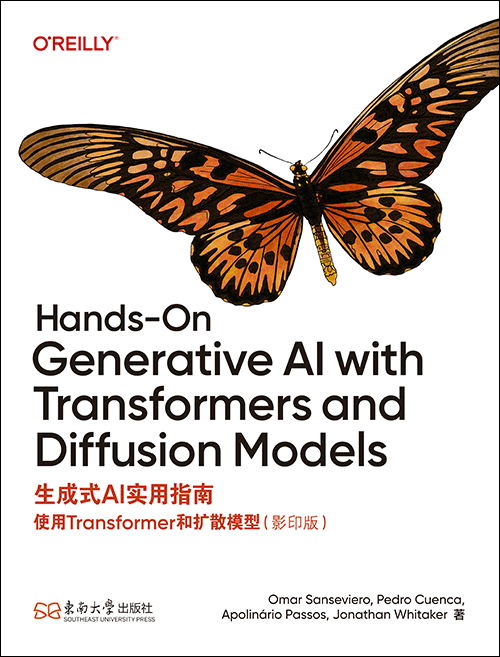
生成式AI实用指南:使用Transformer和扩散模型(影印版)
出版时间:2025年04月
页数:396
“这本书是开发者掌握过去十年最大AI革命背后的工具与概念的必备指南。”
——Lewis Tunstall
Hugging Face机器学习工程师,Natural Language Processing with Transformers合著者
“这本书是生成式AI的最佳入门之选:从全面的解释到贴心的建议和动手练习,应有尽有。”
——Luba Elliott
AI艺术策展人,elluba.com
通过这本实用的动手指南,你可以学习如何使用生成式AI技术创造全新的文本、图像、音频,甚至音乐。你将了解最先进的生成模型的工作原理,学习如何根据需求对其进行微调和适配,以及如何组合现有的构建模块来创造新的模型和进行不同领域的创意应用。
这本入门书从理论概念着手,然后指导读者开展实际应用,并提供了大量代码示例和易懂的插图。你将学习如何使用开源库来利用transformer和扩散模型进行代码探索,并研究若干现有项目来帮助指导你的工作实践。
● 构建和自定义能够生成文本和图像的模型
● 探索使用预训练模型与微调自定义模型之间的权衡
● 创建并使用能够以任意风格生成、编辑、修改图像的模型
● 定制transformer和扩散模型以满足多种创意需求
● 训练能够反映个人独特风格的模型
——Lewis Tunstall
Hugging Face机器学习工程师,Natural Language Processing with Transformers合著者
“这本书是生成式AI的最佳入门之选:从全面的解释到贴心的建议和动手练习,应有尽有。”
——Luba Elliott
AI艺术策展人,elluba.com
通过这本实用的动手指南,你可以学习如何使用生成式AI技术创造全新的文本、图像、音频,甚至音乐。你将了解最先进的生成模型的工作原理,学习如何根据需求对其进行微调和适配,以及如何组合现有的构建模块来创造新的模型和进行不同领域的创意应用。
这本入门书从理论概念着手,然后指导读者开展实际应用,并提供了大量代码示例和易懂的插图。你将学习如何使用开源库来利用transformer和扩散模型进行代码探索,并研究若干现有项目来帮助指导你的工作实践。
● 构建和自定义能够生成文本和图像的模型
● 探索使用预训练模型与微调自定义模型之间的权衡
● 创建并使用能够以任意风格生成、编辑、修改图像的模型
● 定制transformer和扩散模型以满足多种创意需求
● 训练能够反映个人独特风格的模型
- Preface
- Part I. Leveraging Open Models
- 1. An Introduction to Generative Media
- Generating Images
- Generating Text
- Generating Sound Clips
- Ethical and Societal Implications
- Where We’ve Been and Where Things Stand
- How Are Generative AI Models Created?
- Summary
- 2. Transformers
- A Language Model in Action
- A Transformer Block
- Transformer Model Genealogy
- The Power of Pretraining
- Transformers Recap
- Project Time: Using LMs to Generate Text
- Summary
- Exercises
- Challenges
- References
- 3. Compressing and Representing Information
- AutoEncoders
- Variational AutoEncoders
- CLIP
- Alternatives to CLIP
- Project Time: Semantic Image Search
- Summary
- Exercises
- Challenges
- References
- 4. Diffusion Models
- The Key Insight: Iterative Refinement
- Training a Diffusion Model
- In Depth: Noise Schedules
- In Depth: UNets and Alternatives
- In Depth: Diffusion Objectives
- Project Time: Train Your Diffusion Model
- Summary
- Exercises
- Challenges
- References
- 5. Stable Diffusion and Conditional Generation
- Adding Control: Conditional Diffusion Models
- Improving Efficiency: Latent Diffusion
- Stable Diffusion: Components in Depth
- Putting It All Together: Annotated Sampling Loop
- Open Data, Open Models
- Project Time: Build an Interactive ML Demo with Gradio
- Summary
- Exercises
- Challenge
- References
- Part II. Transfer Learning for Generative Models
- 6. Fine-Tuning Language Models
- Classifying Text
- Generating Text
- Instructions
- A Quick Introduction to Adapters
- A Light Introduction to Quantization
- Putting It All Together
- A Deeper Dive into Evaluation
- Project Time: Retrieval-Augmented Generation
- Summary
- Exercises
- Challenge
- References
- 7. Fine-Tuning Stable Diffusion
- Full Stable Diffusion Fine-Tuning
- DreamBooth
- Training LoRAs
- Giving Stable Diffusion New Capabilities
- Project Time: Train an SDXL DreamBooth LoRA by Yourself
- Summary
- Exercises
- Challenge
- References
- Part III. Going Further
- 8. Creative Applications of Text-to-Image Models
- Image to Image
- Inpainting
- Prompt Weighting and Image Editing
- Real Image Editing via Inversion
- ControlNet
- Image Prompting and Image Variations
- Project Time: Your Creative Canvas
- Summary
- Exercises
- References
- 9. Generating Audio
- Audio Data
- Speech to Text with Transformer-Based Architectures
- From Text to Speech to Generative Audio
- Evaluating Audio-Generation Systems
- What’s Next?
- Project Time: End-to-End Conversational System
- Summary
- Exercises
- Challenges
- References
- 10. Rapidly Advancing Areas in Generative AI
- Preference Optimization
- Long Contexts
- Mixture of Experts
- Optimizations and Quantizations
- Data
- One Model to Rule Them All
- Computer Vision
- 3D Computer Vision
- Video Generation
- Multimodality
- Community
- A. Open Source Tools
- B. LLM Memory Requirements
- C. End-to-End Retrieval-Augmented Generation
- Index
书名:生成式AI实用指南:使用Transformer和扩散模型(影印版)
国内出版社:东南大学出版社
出版时间:2025年04月
页数:396
书号:978-7-5766-2006-1
原版书书名:Hands-On Generative AI with Transformers and Diffusion Models
原版书出版商:O'Reilly Media
The animal on the cover of Hands-On Generative AI with Transformers and Diffusion Models is the giant African swallowtail butterfly (Papilio antimachus).
The giant African swallowtail is one of the largest species of butterfly, with a wingspan of up to 9–10 inches (around the size of, say, a dinner plate or vinyl record). Yet, for all of their impressive size, relatively little is known about these colossal insects.
First discovered in 1782, swallowtails live in the tropical rainforests of west and central Africa, where they spend most of their time in the forest canopy; males have occasionally been observed mud-puddling at the forest floor, a behavior in which butterflies aggregate on wet organic matter such as soil or dung in a quest for nutrients.
Because of their diet, giant African swallowtails are highly toxic, and they have no known predators. Though there have been some reports of a population decline resulting from habitat destruction and poaching (specimens are highly prized and can fetch prices of over $1,000), the IUCN has listed the giant African swallowtail as Data Deficient: more information is needed in order for a conservation assessment to be made. Many of the animals on O’Reilly covers are endangered; all of them are important to the world.
The giant African swallowtail is one of the largest species of butterfly, with a wingspan of up to 9–10 inches (around the size of, say, a dinner plate or vinyl record). Yet, for all of their impressive size, relatively little is known about these colossal insects.
First discovered in 1782, swallowtails live in the tropical rainforests of west and central Africa, where they spend most of their time in the forest canopy; males have occasionally been observed mud-puddling at the forest floor, a behavior in which butterflies aggregate on wet organic matter such as soil or dung in a quest for nutrients.
Because of their diet, giant African swallowtails are highly toxic, and they have no known predators. Though there have been some reports of a population decline resulting from habitat destruction and poaching (specimens are highly prized and can fetch prices of over $1,000), the IUCN has listed the giant African swallowtail as Data Deficient: more information is needed in order for a conservation assessment to be made. Many of the animals on O’Reilly covers are endangered; all of them are important to the world.
购买选项
|
© 2026,奥莱利技术咨询(北京)有限公司。版权所有。 传真: +86-10-88097463 京ICP备05003502号 |
|