
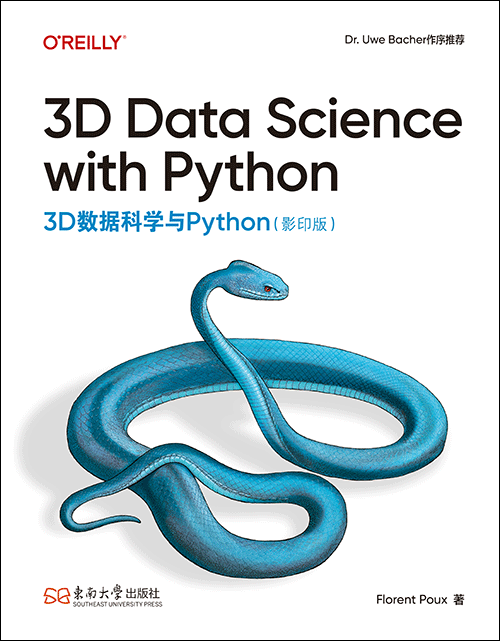
3D数据科学与Python(影印版)
出版时间:2025年07月
页数:658
“我很少见到一本书能把复杂的3D数据工作流程讲得如此易懂。对于真正想掌握3D技术的人来说,这是一本必备之作。”
——Tarun Narayanan Venkatachalam
AI工程师,Unstructured
“这本书可以说为数据科学添加了一个全新的维度。如果你可以用3D思考,又何必满足于平面的认知呢?”
——Lipi Deepaakshi Patnaik
高级软件开发工程师,Zeta
我们的物理世界是建立在三维空间之中的。为了创造能够理解并与之交互的技术,我们的数据也必须是三维的。这本实用指南为数据科学家、工程师、研究人员提供了使用Python处理3D数据的实践方法。从3D重建到3D深度学习技术,你将学习如何从海量数据集中提取有价值的洞察,包括点云、体素、3D CAD模型、网格、图像等。
Florent Poux博士将帮助你借助前沿算法和空间AI模型的潜力,开发以自动化为核心的生产就绪系统(production-ready system)。通过本书,你将习得3D数据科学的知识与代码,实现以下目标:
● 理解3D数据的核心概念和表示方法
● 使用强大的Python库加载、操作、分析和可视化3D数据
● 应用先进的AI算法进行3D模式识别(包括监督与非监督方法)
● 使用3D重建技术生成3D数据集
● 实现自动化3D建模与生成式AI工作流
● 探索在计算机视觉/图形、地理空间情报、科学计算、机器人技术、自动驾驶等领域的实际应用
● 构建服务于空间AI解决方案的精准数字环境
——Tarun Narayanan Venkatachalam
AI工程师,Unstructured
“这本书可以说为数据科学添加了一个全新的维度。如果你可以用3D思考,又何必满足于平面的认知呢?”
——Lipi Deepaakshi Patnaik
高级软件开发工程师,Zeta
我们的物理世界是建立在三维空间之中的。为了创造能够理解并与之交互的技术,我们的数据也必须是三维的。这本实用指南为数据科学家、工程师、研究人员提供了使用Python处理3D数据的实践方法。从3D重建到3D深度学习技术,你将学习如何从海量数据集中提取有价值的洞察,包括点云、体素、3D CAD模型、网格、图像等。
Florent Poux博士将帮助你借助前沿算法和空间AI模型的潜力,开发以自动化为核心的生产就绪系统(production-ready system)。通过本书,你将习得3D数据科学的知识与代码,实现以下目标:
● 理解3D数据的核心概念和表示方法
● 使用强大的Python库加载、操作、分析和可视化3D数据
● 应用先进的AI算法进行3D模式识别(包括监督与非监督方法)
● 使用3D重建技术生成3D数据集
● 实现自动化3D建模与生成式AI工作流
● 探索在计算机视觉/图形、地理空间情报、科学计算、机器人技术、自动驾驶等领域的实际应用
● 构建服务于空间AI解决方案的精准数字环境
- Foreword
- Preface
- 1. Introduction to 3D Data Science
- 3D Data Science in Brief
- 3D Data: Fundamental Building Blocks
- The 3D Data Science Modular Workflow
- 3D Data Science in the Industry
- Summary
- 2. Resources and Software Essentials
- Fundamental Resources
- Hardware Recommendations for 3D
- Essential Software and Tools for 3D
- Summary
- 3. 3D Python and 3D Data Setup
- 3D Python Setup and Libraries
- Creating a 3D Python Program
- 3D Reconstruction Methods
- 3D Dataset: Curation
- Summary
- 4. 3D Data Representation and Structuration
- 3D Data Representations
- 3D Data Canonical Link
- 3D Data Structures: k-d Trees, Octrees, BVH
- Summary
- 5. Developing a Multimodal 3D Viewer with Python
- 3D Python and Code Setup
- 3D Data Curation
- 3D Data Preparation
- Multimodal 3D Experience
- Summary
- 6. Point Cloud Data Engineering
- Fundamentals
- Strategies for Point Cloud Feature Extraction
- Principal Component Analysis
- 3D Data Registration: Unifying Perspectives
- Summary
- 7. Building 3D Analytical Apps
- 3D Project Environment Preparation
- 3D Data Fundamentals with PyVista
- 3D Data Structure Creation (KDTree)
- Covariance Matrix, Eigenvalues, and Eigenvectors
- Planarity, Linearity, Omnivariance, Verticality, Normals
- Neighborhood Definition and Selection
- Automation and Scaling
- Interactive Thresholding
- 3D Data Results Export
- Summary
- 8. 3D Data Analysis
- Types of 3D Data Analysis
- 3D Data Analytical Tools
- 3D Diagnostic Tools
- Summary
- 9. 3D Shape Recognition
- RANSAC from Scratch: 3D Planar Shape Recognition
- Region Growing for 3D Shape Detection
- A Hybrid Approach: RANSAC and Region Growing
- Summary
- 10. 3D Modeling: Advanced Techniques
- High-Fidelity Meshing
- 3D Voxels and Voxelization
- Parametric Modeling
- Monocular Image-based 3D Modeling: Depth Estimation and Reconstruction
- Summary
- 11. 3D Building Reconstruction from LiDAR Data
- Phase 1: 3D Python Setup
- Phase 2: Data Preparation
- Phase 3: Experiments
- Phase 4: Automation and Scaling
- Summary
- 12. 3D Machine Learning: Clustering
- Clustering for Unsupervised Segmentation
- k-Means Clustering
- DBSCAN for Unsupervised Segmentation
- Summary
- 13. Graphs and Foundation Models for Unsupervised Segmentation
- Connectivity-based Clustering
- The Segment Anything Model
- Summary
- 14. Supervised 3D Machine Learning Fundamentals
- From Unsupervised to Supervised Learning
- 3D Point Cloud Semantic Segmentation
- Specializing 3D Machine Learning with 3D Deep Learning
- Summary
- 15. 3D Deep Learning with PyTorch
- 3D Deep Learning Backbone
- Implementation with PyTorch
- 3D Deep Learning: The Architectures
- 3D Machine Learning Versus 3D Deep Learning
- Fine-Tuning, Transfer Learning, and 3D Data Augmentation
- Summary
- 16. PointNet for 3D Object Classification
- PointNet: A Point-based 3D Deep Learning Architecture
- 3D Object Classification
- Large-Scale Semantic Segmentation Considerations
- Summary
- 17. The 3D Data Science Workflow
- 3D Data Acquisition
- 3D Data Preparation and Engineering
- 3D Data Modeling
- Semantic Extraction
- 3D Data Visualization and Analysis
- Summary
- 18. From 3D Generative AI to Spatial AI
- Advanced 3D Projects
- Spatial AI: The Future of 3D Experiences
- Conclusion
- Index
书名:3D数据科学与Python(影印版)
作者:Florent Poux 著
国内出版社:东南大学出版社
出版时间:2025年07月
页数:658
书号:978-7-5766-2003-0
原版书书名:3D Data Science with Python
原版书出版商:O'Reilly Media
The animal on the cover of 3D Data Science with Python is a blue viper (Trimeresurus insularis). Also known as the white-lipped island pit viper, blue vipers are closely related to the white-lipped pit viper.
As the name suggests, blue vipers are known for their vibrant blue scales. This makes them extremely rare, as most of the snakes in this species are green. The scales can range from a bright, electric blue to a pale, powdery blue and often have an iridescent or metallic appearance.
Blue vipers are native to Komodo Island but can be found in other areas of southeast Asia as well. They prefer forested areas such as monsoon forests, bushlands, and bamboo forests where their blue coloration helps them blend in with their surroundings. Blue vipers are arboreal (tree dwellers) and nocturnal, waiting until nighttime to hunt their prey (rodents, birds, lizards, frogs, and other small mammals).
Although not generally aggressive, blue vipers will fight when provoked. They have hollow fangs which they use to inject venom into their prey. These snakes are poisonous to humans, but there are antidotes.
As the name suggests, blue vipers are known for their vibrant blue scales. This makes them extremely rare, as most of the snakes in this species are green. The scales can range from a bright, electric blue to a pale, powdery blue and often have an iridescent or metallic appearance.
Blue vipers are native to Komodo Island but can be found in other areas of southeast Asia as well. They prefer forested areas such as monsoon forests, bushlands, and bamboo forests where their blue coloration helps them blend in with their surroundings. Blue vipers are arboreal (tree dwellers) and nocturnal, waiting until nighttime to hunt their prey (rodents, birds, lizards, frogs, and other small mammals).
Although not generally aggressive, blue vipers will fight when provoked. They have hollow fangs which they use to inject venom into their prey. These snakes are poisonous to humans, but there are antidotes.
购买选项
|
© 2026,奥莱利技术咨询(北京)有限公司。版权所有。 传真: +86-10-88097463 京ICP备05003502号 |
|