
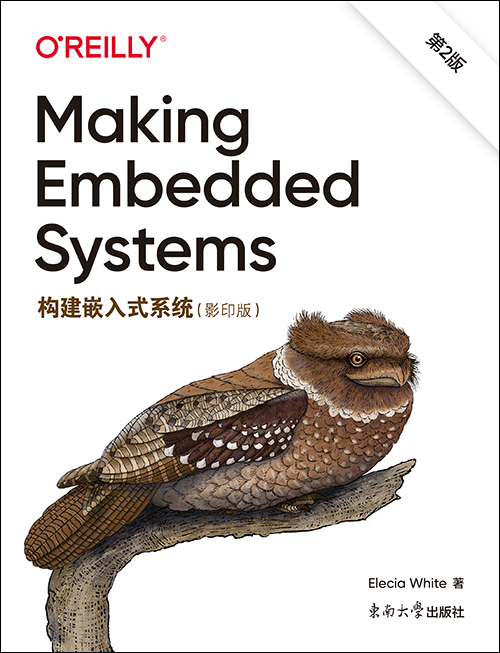
构建嵌入式系统 第2版(影印版)
出版时间:2025年02月
“Elecia White再次归来!这本备受赞誉之作的第2版使嵌入式软件开发这一引人入胜的主题变得平易近人且充满乐趣。书中涵盖了所有必要的基本主题,帮助新手了解嵌入式开发流程、模式、工具的复杂性。”
——Miro Samek
嵌入式系统专家、作家、教师
你对嵌入式系统开发感兴趣吗?因为嵌入式系统无法容忍低效率,所以对编程方法要求严格。这本易读的指南可以帮助你根据经典软件设计模式和嵌入式编程独有的新模式培养良好的开发实践。你将学习如何为处理器而不是操作系统构建系统架构,发现各种应对硬件问题、设计变化、制造需求的技术。
本书的作者是一位领域专家,开发过从DNA扫描仪到儿童玩具等各种系统。本书非常适合中高级程序员,无论你使用什么平台。这个经过扩展的第2版新增了IoT和网络传感器、电机与运动、调试、数据处理策略等相关章节。
● 优化系统以降低成本并提高性能
● 开发架构,使软件在资源受限的环境中保持稳健
● 探索传感器、显示器、电机、其他I/O设备
● 减少RAM、代码空间、处理器周期、功耗
● 学习如何解读原理图、数据表、电源需求
● 探索如何在小型处理器上实现复杂数学运算
● 为物联网和网络传感器设计高效的嵌入式系统
——Miro Samek
嵌入式系统专家、作家、教师
你对嵌入式系统开发感兴趣吗?因为嵌入式系统无法容忍低效率,所以对编程方法要求严格。这本易读的指南可以帮助你根据经典软件设计模式和嵌入式编程独有的新模式培养良好的开发实践。你将学习如何为处理器而不是操作系统构建系统架构,发现各种应对硬件问题、设计变化、制造需求的技术。
本书的作者是一位领域专家,开发过从DNA扫描仪到儿童玩具等各种系统。本书非常适合中高级程序员,无论你使用什么平台。这个经过扩展的第2版新增了IoT和网络传感器、电机与运动、调试、数据处理策略等相关章节。
● 优化系统以降低成本并提高性能
● 开发架构,使软件在资源受限的环境中保持稳健
● 探索传感器、显示器、电机、其他I/O设备
● 减少RAM、代码空间、处理器周期、功耗
● 学习如何解读原理图、数据表、电源需求
● 探索如何在小型处理器上实现复杂数学运算
● 为物联网和网络传感器设计高效的嵌入式系统
- Preface
- 1. Introduction
- Embedded Systems Development
- Prototypes and Maker Boards
- Further Reading
- 2. Creating a System Architecture
- Getting Started
- Creating System Diagrams
- Designing for Change
- Creating Interfaces
- A Sandbox to Play In
- Back to the Drawing Board
- Further Reading
- 3. Getting Your Hands on the Hardware
- Hardware/Software Integration
- Reading a Datasheet
- Your Processor Is a Language
- Reading a Schematic
- Practice Reading a Schematic: Arduino!
- Keep Your Board Safe
- Creating Your Own Debugging Toolbox
- Testing the Hardware (and Software)
- Dealing with Errors
- Further Reading
- 4. Inputs, Outputs, and Timers
- Handling Registers
- Toggling an Output
- Separating the Hardware from the Action
- The Input in I/O
- Momentary Button Press
- Runtime Uncertainty
- Using a Timer
- Using Pulse-Width Modulation
- Shipping the Product
- Further Reading
- 5. Interrupts
- A Chicken Presses a Button
- An IRQ Happens
- Save the Context
- Retrieve the ISR from the Vector Table
- Call the ISR
- Restore the Context
- Configuring Interrupts
- When and When Not to Use Interrupts
- Further Reading
- 6. Managing the Flow of Activity
- Scheduling and Operating System Basics
- State Machines
- Watchdog
- Main Loops
- Further Reading
- 7. Communicating with Peripherals
- Serial Communication
- Communications in Practice
- Circular Buffers
- Further Reading
- 8. Putting Together a System
- Key Matrices
- Segmented Displays
- Pixel Displays
- External Flash Memory
- Analog Signals
- Digital Sensors
- Data Handling
- Calculating Needs: Speeds and Feeds
- Further Reading
- 9. Getting into Trouble
- Fighting with the Compiler Optimizations
- Impossible Bugs
- Creating Chaos and Hard Faults
- Debugging Hard Faults
- Merely Very Difficult Bugs
- Consequences of Being Clever
- Further Reading
- 10. Building Connected Devices
- Connecting Remotely
- Robust Communication
- Updating Code
- Managing Large Systems
- Manufacturing
- Further Reading
- 11. Doing More with Less
- Need More Code Space
- Need More RAM
- Need More Speed
- Summary
- Further Reading
- 12. Math
- Identifying Fast and Slow Operations
- Using an Existing Algorithm
- Designing and Modifying Algorithms
- Fake Floating-Point Numbers
- Machine Learning
- Look Up the Answer!
- Further Reading
- 13. Reducing Power Consumption
- Understanding Power Consumption
- Turn Off the Light When You Leave the Room
- Putting the Processor to Sleep
- Further Reading
- 14. Motors and Movement
- Creating Movement
- Position Encoding
- Driving a Simple DC Motor with PWM
- Motor Control
- Ten Things I Hate About Motors
- Further Reading
- Index
书名:构建嵌入式系统 第2版(影印版)
作者:Elecia White 著
国内出版社:东南大学出版社
出版时间:2025年02月
书号:978-7-5766-1768-9
原版书书名:Making Embedded Systems, 2nd Edition
原版书出版商:O'Reilly Media
The animal on the cover of Making Embedded Systems is a great-eared nightjar. Greateared nightjars are members of the family Caprimulgidae and inhabit subtropical or tropical moist lowland forests in Southeast Asia.
Great-eared nightjars are crepuscular, meaning mostly active at dusk and at night, during which time they satisfy their diets of flying insects and moths. Their calls are a distinctive, sharp “tissk,” followed by a two-syllable “ba-haw.”
These birds have pronounced ear tufts, which, in addition to their average length of 16 inches, make them more conspicuous among nightjars. Their soft gray and brown plumage resembles their preferred habitat, leaf litter and bracken. They lay their eggs either directly on bare ground or in leaf-litter nests on the ground. Nightjar nestlings have been observed to be completely silent and motionless, which, in addition to their leaf-colored plumage, may help protect them from danger while nesting.
Great-eared nightjars are crepuscular, meaning mostly active at dusk and at night, during which time they satisfy their diets of flying insects and moths. Their calls are a distinctive, sharp “tissk,” followed by a two-syllable “ba-haw.”
These birds have pronounced ear tufts, which, in addition to their average length of 16 inches, make them more conspicuous among nightjars. Their soft gray and brown plumage resembles their preferred habitat, leaf litter and bracken. They lay their eggs either directly on bare ground or in leaf-litter nests on the ground. Nightjar nestlings have been observed to be completely silent and motionless, which, in addition to their leaf-colored plumage, may help protect them from danger while nesting.
购买选项
|
© 2026,奥莱利技术咨询(北京)有限公司。版权所有。 传真: +86-10-88097463 京ICP备05003502号 |
|